Later layers know no more
How does data flow through a neural network?
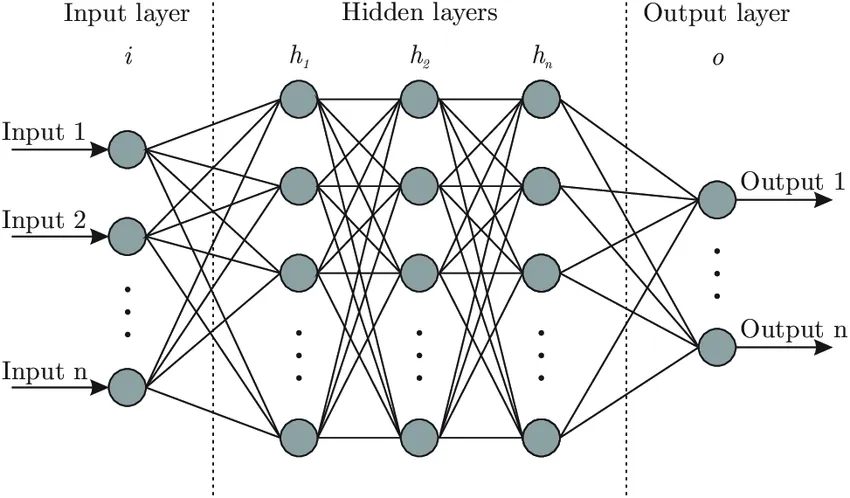
In NNs, information is passed from the input layer to intermediate hidden layers, and finally to the output layer .
But why do we have so many layers? We’re “learning”, but what is actually happening to the information?
Crucially, we can never add new information to existing information as it is propagated through the layers of a neural network.
If we represent the input, hidden, and output layers as random variables, , , , with the dependency
Then the mutual information of our random variables is such that:
Why is this the case? One intuitive answer might be that we can’t add more information to our network. We can either keep the existing information content (), or decrease it ().
It’s easy to get tripped up on intuition, so let’s treat this formally.
Proof
The mutual information for two random variables, and , measures how much uncertainty is reduced about variable when is observed.
Let’s think about the extreme cases here.
We know that
This is the chain rule of entropy, and it’s actually the log transformed version of the joint probability from the good ol’ product rule (take a second to think about why!)
So we can write our mutual information equation as:
The terms cancel out, leaving us with
Now, going back to our dependency, note that if is Markovian, then by definition:
- is computed based on just and
- is computed based on just .
Since in our case, (the input) completely determines (intermediate layers), then once we observe there is no uncertainty left about at all, and .
Thus,
By the same argument, we can see that
And applying entropy chain rule:
Recall that , and set these two equal:
We can write our entropy in terms of mutual information to get:
Uncertainty must always be non-negative (no such thing as negative uncertainty.)
So we can rewrite the above as a bound
And that’s how you get the Data Processing Inequality.
Implications
But let’s think about what this means. If every layer can have no more information than layer , how come the later layers of a neural network work the best (e.g. in a classifier)?
To answer this, I turn to Understanding intermediate layers using linear classifier probes1:
One of the important lessons is that neural networks are really about distilling computationally-useful representations, and they are not about information contents as described by the field of Information Theory.
Footnotes
-
Alain & Bengio (2016), arxiv.org/abs/1610.01644
↩